

The PodSwap Operator
The agent that designed this company, then went and ran it
Most software is built by a team and then, later, has some AI added to it. This was the other way around. An autonomous agent built by QQuantum.ai produced the brand, the prototype, the site, the corpus, the apps and the press — and it has not stopped. What follows is the ledger, and most of it points at something you can go and look at.
The AI runs the system. People do the engagement.
The agent has no Instagram credentials and never will. It is allowed to build, write, design, publish and pitch. It is not allowed near a creator's account, and the product is architected so that it cannot be.
The ledger
Everything it has actually shipped
-
01
The design and the working prototype
ShippedEvery screen on this site, and the clickable prototype behind it, came out of the agent before a single line was written by hand.
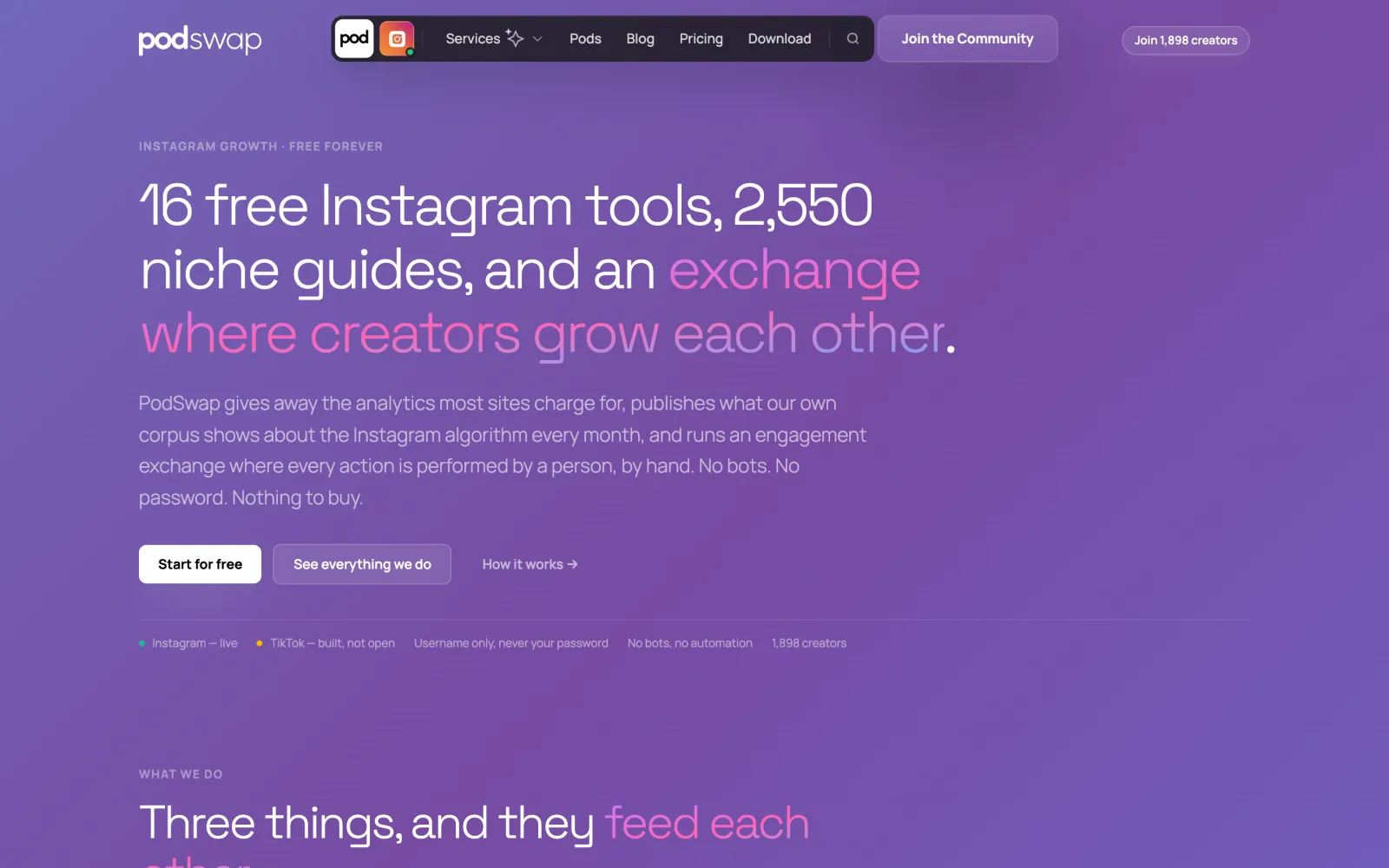
The layout system, the type scale, the shimmer cards, the dark surface treatment and the motion language were designed as one system rather than assembled page by page. The prototype was interactive from the start, so the design was argued with by clicking it rather than by describing it.
 The build, documented
-
02
The mark, the palette and the name
ShippedBrand identity generated and iterated by the agent: the wordmark, the colour system and the vocabulary the whole site is written in.
The gradient reserved for headline subjects, the eyebrow convention above every section, the refusal of italics and heavy weights — these are enforced conventions, not preferences, and they came from the same pass that produced the mark.
-
03
Thousands of niche guides, written on demand
RunningThe agent writes a platform growth guide when 5 creators ask for one, not before.
Most programmatic SEO generates everything and hopes. This does the opposite: a guide is written only once 5 people have voted for that niche and platform combination. Demand comes first and the writing follows it, which is why the corpus is large without being filler. The generator is also instructed against its own worst habits, with an explicit ban on the vocabulary that makes machine-written prose obvious.
Browse the corpus -
04
The relationship graph between niches
RunningWhich niches are genuinely adjacent is a judgement, and the agent makes it across the whole taxonomy.
Internal linking on this site is not a keyword match. The agent reads each niche and proposes its real semantic siblings, and those relationships are what a reader follows from one guide to the next.
The niche directory -
05
The 30 points a rubric cannot grade
ShippedPodscore is 100 points. Seventy of them are deterministic rules. The other 30 need a language model to read your hook.
Structure, call to action, length and hashtag hygiene are all measurable with regular expressions, and the grader in your browser measures them. Whether a hook actually earns the second line is not measurable that way. Rather than approximate it and quietly understate every caption, the browser grader reports out of 70 and says so.
The rubric, in full -
06
A monthly report on the Instagram algorithm
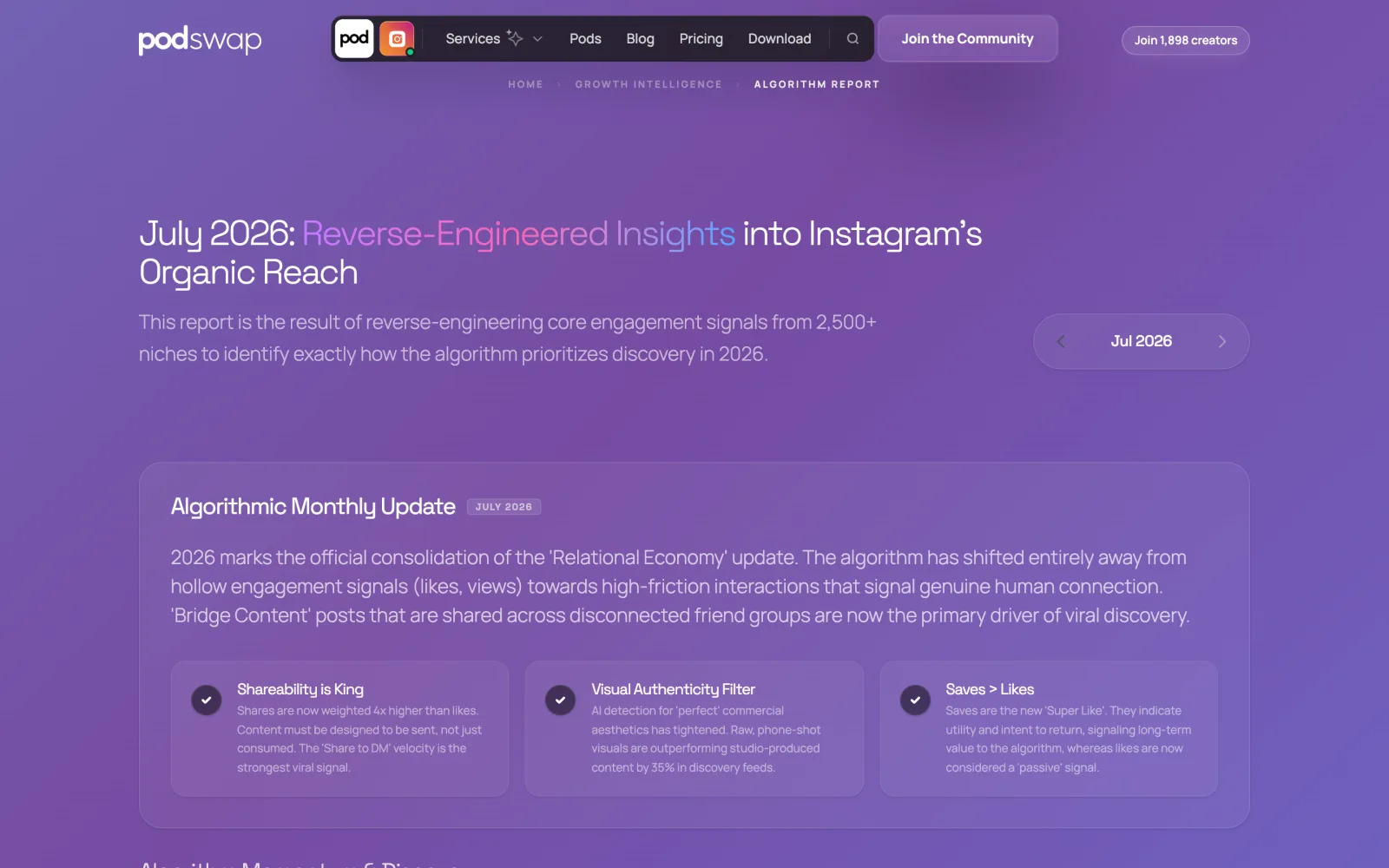
RunningBuilt from the network's own aggregated engagement data, published every month, with the outliers capped and labelled rather than hidden.
Posting time, weekday, reel duration, carousel depth, hashtag count, caption metrics, collaboration impact, format discovery — sliced by niche and by follower bracket. Extreme engagement rates are capped and marked as capped, and the smallest accounts are excluded from the bracket statistics — the report excludes accounts under 500 followers from that block, and this site drops anything under 100 from the follower-performance slice on top. Where the upstream data has no figure the section is omitted rather than estimated, and one block that arrives pre-filled with placeholder values is suppressed here rather than published.
 The intelligence hub
-
07
Press written and pitched, without a press release
RunningThe agent researches journalists and publishers, writes an individual pitch for each, and sends it on a throttle.
It builds its own database of journalists and the publications they write for, composes a pitch per journalist rather than a template with a merge field, and holds a per-domain throttle so no single publication is hit twice in a day. Subject lines are checked against each other for variance, bounces are classified, and replies are read back in. It is explicitly instructed that it is not a PR agency and is not writing a press release; the words "Press release", "Exclusive:" and "Data:" are banned from subject lines and stripped if they appear anyway.
-
08
The email engine and the weekly reports
Partly runningCampaigns, sequences and digests, dispatched without a person scheduling them. The weekly performance report is built and currently switched off.
Chunked campaign processing, bounce and complaint handling, and a scheduled dispatcher. The weekly report tells a creator what their week actually did, drawn from their own numbers — its schedule is disabled in the product while the figures it reports are corrected, and this entry said "Running" while that was true of only part of it.
-
09
Native apps on five platforms
ShippedWindows, macOS, Linux and Android shipped. iOS in internal beta.
The same system, packaged natively, from the same agent-authored codebase rather than a separate mobile team.
Download the app -
10
Its own indexing and integrity checks
RunningThe agent submits its pages for indexing, verifies its own generated markup and repairs what it broke.
Heading hierarchy, table structure and outbound links are checked on a schedule. A broken link is stripped while its anchor text is kept, so a paragraph never collapses into a dangling clause.
The sitemap
The boundary
And here is what it is never allowed to do
A page about how capable an AI is has an obvious failure mode, so this list is published at the same size as the one above it. These are not roadmap items. They are things the system is built to keep the model out of.
Every engagement
Every comment, save, share, follow and story view on PodSwap is performed by a person, by hand, inside the Instagram app. The agent has no access to your account, no password and no session. There is no automation on your account to detect, because there is none.
Every dispute
When delivery is contested, a human moderator reads the screenshot and decides. Penalties run both ways: a false report costs the person filing it exactly what an upheld report costs the person who did not deliver.
Every judgement about your account
PodSwap does not predict your reach, does not promise you followers, and does not tell you your post will go viral. The tools grade what is measurable and stop where measurement stops.
Questions
What people ask about the agent
What is The PodSwap Operator?
The autonomous AI agent, built by QQuantum.ai, that designed PodSwap and now operates it. It produced the brand and the working prototype, writes the niche research corpus, ships the apps, publishes the monthly Instagram algorithm report and writes the press outreach.
Does the agent have access to my Instagram account?
No, and it cannot be given access. PodSwap holds no password and no session token for any creator and does not use the official Instagram API. The agent builds and runs the platform; every engagement in the exchange is performed by a person, by hand, in the Instagram app.
Who built the AI behind PodSwap?
QQuantum.ai, an applied AI consultancy specialising in AI architectures, autonomous agents, algorithmic marketing, creative design and rapid prototyping. Their case study on this build is at https://qquantum.ai/work/podswap.
Does the AI write the press releases and email journalists?
It writes and sends the outreach, but deliberately not as press releases. It researches journalists and the publications they write for and composes an individual pitch for each one rather than a template with a merge field, holding a per-domain throttle so no publication is contacted twice in a day. It is explicitly instructed that it is not a PR agency, and the phrases "Press release", "Exclusive:" and "Data:" are banned from subject lines and stripped if they appear anyway. A generic release blasted to a list is the thing journalists ignore, so the system is built not to produce one.